Disclosure: This post contains affiliate links. If you buy through them, we may earn a commission at no extra cost to you. Learn more.
Every business that makes money online runs on the same invisible machine: the marketing funnel. It’s not a tactic or a tool — it’s the journey a stranger takes from “never heard of you” to “repeat customer who tells friends.” Once you understand it, every marketing decision gets simpler.
This guide explains the marketing funnel in plain language: the four stages (attract, nurture, convert, retain), what to do at each one, the metrics that matter, and how to build a working funnel this week — even if you’re starting from zero.
What Is a Marketing Funnel, Exactly?
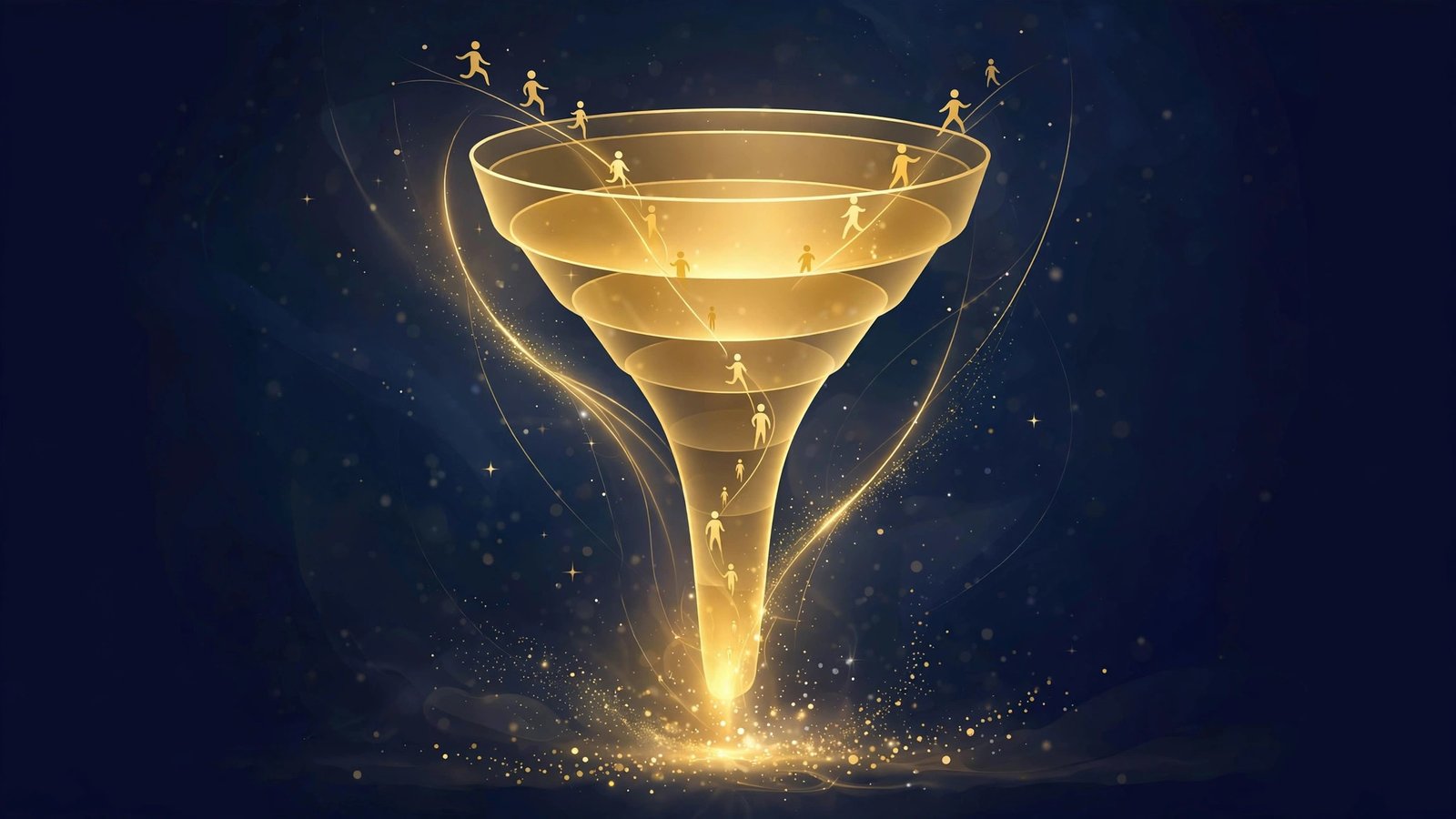
Picture a funnel: wide at the top, narrow at the bottom. Thousands of people enter at the top (they see your content), a smaller number move down (they engage and trust you), fewer still reach the bottom (they buy), and the best ones come back around (they buy again).
The funnel shape isn’t a flaw — it’s reality. Not everyone who discovers you will buy, and that’s fine. The funnel’s job is to make sure the right people keep moving down instead of leaking out. Most struggling businesses don’t have a traffic problem; they have a leaky funnel — visitors arrive, but nothing guides them toward a purchase.
Stage 1: Attract — Get Discovered by the Right People
The top of the funnel is about visibility. Your only goal here: get your ideal customers to notice you exist. Not to buy — just to notice.
What works at this stage
- Short-form video: TikTok, Reels, and Shorts are the fastest discovery engines in 2026. One viral video can put 100,000 strangers into your funnel in a day.
- SEO content: blog posts and YouTube videos that answer the exact questions your customers Google. Slower than social, but the traffic compounds for years.
- Paid ads (later): once you know what message works organically, ads let you buy attention at scale. Never start here — amplify winners, don’t fund experiments.
The metric that matters: reach and new visitors
At the attract stage, track how many new people discover you weekly and which content brings them. Ignore sales metrics here — judging top-of-funnel content by immediate revenue is like judging a first date by whether it led to marriage.
Common mistake
Trying to sell at the attract stage. A stranger who just discovered you doesn’t trust you yet. Pitching now feels like a proposal on the first date — it pushes people away instead of pulling them in.
Stage 2: Nurture — Turn Attention Into Trust
Attention is worthless without trust. The nurture stage is where strangers become followers, subscribers, and eventually believers. This is the stage most beginners skip — and it’s why their funnels leak.
What works at this stage
- Email sequences: the highest-ROI nurture tool in existence. A 5–7 email welcome sequence that delivers genuine value (tips, stories, case studies) converts cold subscribers into warm prospects on autopilot.
- Consistent valuable content: the 80/20 rule — 80% education and entertainment, 20% promotion. Every useful post is a trust deposit.
- Social proof: testimonials, results, behind-the-scenes content. People trust people like them more than they trust your claims.
- Retargeting: showing content to people who already visited your site or watched your videos. Warm audiences convert 3–5x better than cold ones because the trust-building already started.
The metric that matters: engagement depth
Track email open rates (aim for 30%+), reply rates, saves and shares, and returning visitors. These measure trust, not just attention. A growing list of engaged subscribers is a growing asset — it’s the part of your funnel no algorithm can take away.
Common mistake
Going silent after capturing attention. Someone follows you or joins your list, and then hears nothing for three weeks. Nurture requires consistency — a weekly email and regular posts keep the relationship warm until they’re ready to buy.
Stage 3: Convert — Turn Trust Into Revenue
Only now — after attraction and nurturing — do you ask for the sale. By this point, the prospect knows you, trusts you, and understands what you offer. Converting is no longer convincing; it’s facilitating.
What works at this stage
- A clear, simple offer: one product, one price, one call to action. Confused prospects don’t buy — they leave. If your offer needs a 20-minute explanation, simplify the offer.
- Risk reversal: guarantees, free trials, and easy returns remove the fear of buying. Every objection you eliminate increases conversion.
- Urgency and scarcity (honest): limited bonuses, enrollment windows, and genuine stock limits push ready buyers off the fence. Fake countdown timers destroy trust — use real constraints.
- Optimized checkout: every extra step in your checkout loses 10–20% of buyers. One page, guest checkout, mobile-first. Test it on your phone before you launch.
The metrics that matter: conversion rate and average order value
A healthy e-commerce funnel converts 1–3% of visitors into buyers. If you’re below 1%, the problem is usually the offer, the price, or trust signals — not traffic volume. Average order value matters just as much: increasing it by 20% through bundles and upsells is often easier than increasing traffic by 20%.
If you’re building the “convert” stage from scratch, it helps to study proven models. Our breakdown of how to start dropshipping on Shopify in 2026 walks through building a store designed to convert — product pages, offers, and checkout flow included.
Common mistake
Driving cold traffic straight to a buy page. Without the attract and nurture stages, conversion rates collapse — you pay for clicks from people who were never warmed up. The funnel works as a system; skipping stages breaks it.
Stage 4: Retain — Turn Buyers Into Repeat Revenue
Here’s the math most beginners miss: acquiring a new customer costs 5–7x more than selling to an existing one. The retain stage — post-purchase emails, loyalty, upsells, referrals — is where real profit lives.
What works at this stage
- Post-purchase email sequence: order confirmation, shipping updates, a “how to get the most from your purchase” email, and a review request. This sequence alone can double repeat purchase rates.
- Upsells and cross-sells: recommend complementary products after purchase. A customer who just bought is 60–70% more likely to buy again than a cold prospect.
- Loyalty and referrals: reward repeat buyers and give them a reason to bring friends. Referred customers convert at higher rates and cost you almost nothing to acquire.
- Win-back campaigns: automated emails to customers who haven’t bought in 60–90 days. A simple “we miss you — here’s 15% off” recovers revenue you’d otherwise lose forever.
The metric that matters: repeat purchase rate and customer lifetime value
Track what percentage of customers buy again within 90 days, and the total revenue per customer over time. Businesses with strong retain stages can afford to spend more acquiring customers — which lets them outbid competitors at the attract stage. Retention is a competitive weapon, not just a nice-to-have.
Putting It Together: A Simple Funnel You Can Build This Week
Theory is nice; here’s the minimum viable funnel, buildable in 5–7 days:
- Attract: post one short-form video daily for 7 days, each ending with a CTA to a free resource.
- Nurture: the free resource (a checklist or mini-guide) requires an email to download. New subscribers get a 5-email welcome sequence over 10 days.
- Convert: email 4 and 5 introduce your core offer with a clear guarantee and a single buy link. Your store or sales page has one product, one price, one CTA.
- Retain: buyers enter a post-purchase sequence: thank-you, usage tips, review request at day 14, complementary product offer at day 30.
That’s it. One traffic source, one lead magnet, one email sequence, one offer, one follow-up sequence. Start simple, measure each stage’s conversion rate, and fix the leakiest stage first.
How to Diagnose Your Funnel
When revenue stalls, the funnel tells you exactly where to look:
- Lots of traffic, no email signups: your attract content is fine but your lead magnet is weak — or missing entirely.
- Growing list, no sales: nurture problem. Your emails aren’t building enough trust, or you’re never actually making an offer.
- Sales but no repeat buyers: retain problem. No post-purchase follow-up means you’re re-paying acquisition costs for every dollar of revenue.
- Everything is low: offer problem. Go back to fundamentals — is this something your specific audience urgently wants?
Frequently Asked Questions
Do I need all four stages from day one?
You need the structure, not the complexity. The minimum viable version above covers all four stages in their simplest form. What you don’t need on day one is advanced automation, multiple traffic sources, or a 30-email sequence. Start simple; expand the stage that’s working.
How long does it take to build a working funnel?
The basic version in this guide: one focused week. A refined funnel that converts predictably: 60–90 days of testing and iteration. Funnels are never “done” — you continuously improve the weakest stage based on data.
What’s a good conversion rate at each stage?
Benchmarks: visitor-to-subscriber 2–5% (with a good lead magnet), email open rates 30%+, subscriber-to-customer 1–5% depending on price point, and repeat purchase rates of 20–30% within 90 days for consumable products. Below these ranges, fix that stage before adding more traffic.
Can a funnel work without paid ads?
Absolutely. Organic content (social, SEO, YouTube) feeds the attract stage for free — it just takes longer to scale. Many profitable businesses run entirely on organic funnels. Ads become useful when you have a proven funnel and want to scale it faster, not before.
What’s the difference between a marketing funnel and a sales funnel?
They’re usually the same concept viewed from different angles. “Marketing funnel” typically covers attract and nurture (marketing’s job); “sales funnel” emphasizes convert (closing the sale). This guide covers all four stages as one system because in a small business, it’s all one job: yours.
Have a project in mind?
Let's create something extraordinary.
Reach out today — we'll get back to you fast.